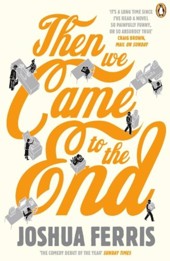
Book Review: Then we Came to the End' by Joshua Ferris
I graduated with a degree in English in the early 1990s. This was at a time of economic collapse that followed from the Lawson credit boom of the late 1980s. Seeking work, I took a job as a clerical assistant in an insurance company. So began my familiarisation with office life.
I thought that the office might be the stuff of modern life and it could be an environment that contemporary literature should investigate and set down on paper for thoughtful reflection, just as Dickens had explored the workspaces of Victorian England.
But nothing seemed to happen in the office that was worthy of a story, really. A young man died from cancer, colleagues had affairs, clerks left to join a different insurance company that had developed a more cost-efficient method of selling insurance. And always people shared stories of the tragedies that had happened in their lives when they met, on a Thursday evening, down a local pub. These tales were interspersed with familiar and well-tried humour (and Friday evening times were reserved for families and lovers who existed elsewhere).
But none of this seemed significant within the daily dull routine of arriving at the office, flashing an identity card to security on the door, and signing on a flex card before settling down at a green-screen VDU to input data throughout the day as phones rang and people annoyed each other by talking too loudly.
Now, I am enjoying reading 'Then we came to the end' by Joshua Ferris. This novel is 'billed' as a comedy about office life, and it appears to begin like that.
You turn the pages expecting the likes of David Brent and Gareth Keenan from ‘The Office’ to pop out at you, pathetically trying to make their roles seem important as they stand there for inspection, embarrassingly awkward.
However, an epigraph quoting Ralph Waldo Emerson quickly alerts us that the novel may be more than a satire, particularly when we encounter a stressed manager who quotes Emerson and gives copies of Emerson’s writings to members of his staff.
(And the ‘acknowledgements’ page, at the end of the novel, alerts the reader to the fact that Ferris has taken the title of his book from the first sentence of DeLillo’s first novel ‘Americana’: there are few writers more ambitious than DeLillo to explore the meaning of American identity, suffused with media influence, in the late 20th century).
While I laughed out loud when the office staff were having meetings about meetings about meetings that had discussed if the office could work more efficiently, a sense of unease was creeping into my generic understanding of this novel.
As I caught glimpses of tragedies in the characters’ lives, I began to ask questions:
Why was one worker gifting a totem pole to a fellow worker in his will, when this was the one thing that he 'owned' that should not be passed to another person using standard legal processes?
Why was the murder of a colleague's daughter mentioned and quickly lost in the background below the everyday events of office interactions?
Why is a partner of the firm appearing to try to keep the possibility that she has breast cancer both secret and poignantly visible at the same time?
There is the inevitable and casual cruelty of office gossip, but when the novel switches from first person plural narration to a passage told by an omniscient narrator, I wondered if this all-revealing section wasn’t, in fact, the greatest invasion of privacy of all, because it could not be dismissed as ‘only gossip’ (and only towards the end of the book, is it emphasised, that this was fiction after all).
By the end of the novel, the reader is left wondering what ‘we’ means in the workplace and whether there isn’t, in fact, a type of misanthropy that denigrates the simple efforts of a team to share a space together, and to produce some nonsense that amuses for a short period of time and which earns another day’s living.
Thoreau, inspired by Emerson, said he went to the woods to ‘front the essential facts of life’, but in so doing, perhaps he over-looked that the essential facts of life might just be a little giggle about stealing a colleague’s chair, and how such a knowing interaction might just set the narrative foundations of genuine human relationships that provide comfort and support in lives destined to end in some sort of tragedy.
This seems a novel about America and a novel for our times, or at least the times we lived in before the contemporary world of mass internet connection, social media, and home working.
And the final line of the novel tells us that we were a part of it, all along.
Latest News & Activity